 Coingecko
Coingecko market cap: Supply and Dilution Risk
Coingecko market cap measures a token’s circulating valuation by multiplying its reference price by its circulating supply. Comparing that figure with fully diluted valuation (FDV) reveals the value assigned to the total or maximum supply used in that calculation at the same price. A wide gap makes release schedules and allocation conditions relevant to a purchase decision. Future dilution depends on how supply enters circulation and how demand responds; the gap alone doesn’t predict a price decline.
Future issuance can create dilution risk even when market cap matches FDV calculated from existing total supply.
Valuation before a token purchase
Before treating a small market cap as a cheap entry, check which supply figure FDV uses, then compare the valuations. A low unit price can accompany a large circulating valuation. Conversely, a small circulating market cap can reflect a small public float, with much more supply reserved elsewhere. Neither pattern establishes that a token offers good value. Assess whether the apparent valuation still makes sense after accounting for supply that could become available during the intended holding period.
A displayed market cap doesn’t confirm a purchase. Your wallet or trading account balance shows the tokens you actually hold.
Circulating supply and the FDV gap
Circulating supply estimates the tokens available for public trading, while total supply includes existing tokens that remain outside circulation. Total supply counts minted tokens after burns. A total-supply FDV values all those tokens at the reference price. Both metrics therefore share a price input, although they describe different quantities of tokens.
With a shared price input and nonzero total-supply FDV, the market cap-to-FDV ratio equals circulating supply divided by total supply. The price cancels out. At nonzero prices, price movements alone won’t change that ratio when both supply figures stay constant.
A ratio close to 1 means most of the total supply already counts as circulating. A lower ratio signals a larger excluded share. It doesn’t give that share a release date. Treasury holdings with no distribution plan and tokens with a scheduled vesting release can contribute to similar gaps while presenting different supply risks.
If circulating supply is positive and stays unchanged, new minting increases total supply and lowers the circulation ratio.
What does a missing circulating supply mean?
A missing circulating-supply figure leaves the circulating valuation unresolved because the calculation needs that token count. A dash in the market-cap field means the platform lacks sufficient circulating-supply information or doubts its accuracy. FDV may remain available because it uses another supply figure. Market-data API responses also allow null supply values. Missing data differs from a verified zero; replacing a blank with zero creates a false comparison.
A supply comparison with complete or missing data
In this hypothetical comparison, the reference price is $0.374 per token in US dollars, circulating supply is 1,284,000 tokens, and total supply is 4,280,000 tokens. The reader wants to calculate the circulating share before placing any trade.
The reader can compare the displayed valuations or calculate both from these inputs. Either option needs matching token identity, observation time, and price basis. Here, the available supply counts allow a direct calculation.
Market cap is $0.374 × 1,284,000 = $480,216. FDV is $0.374 × 4,280,000 = $1,600,720. Dividing $480,216 by $1,600,720 gives 0.30, or 30%. The other 70% of total supply doesn’t count as circulating. That portion amounts to 2,996,000 tokens. Increasing circulating supply while holding total supply constant would raise this percentage.
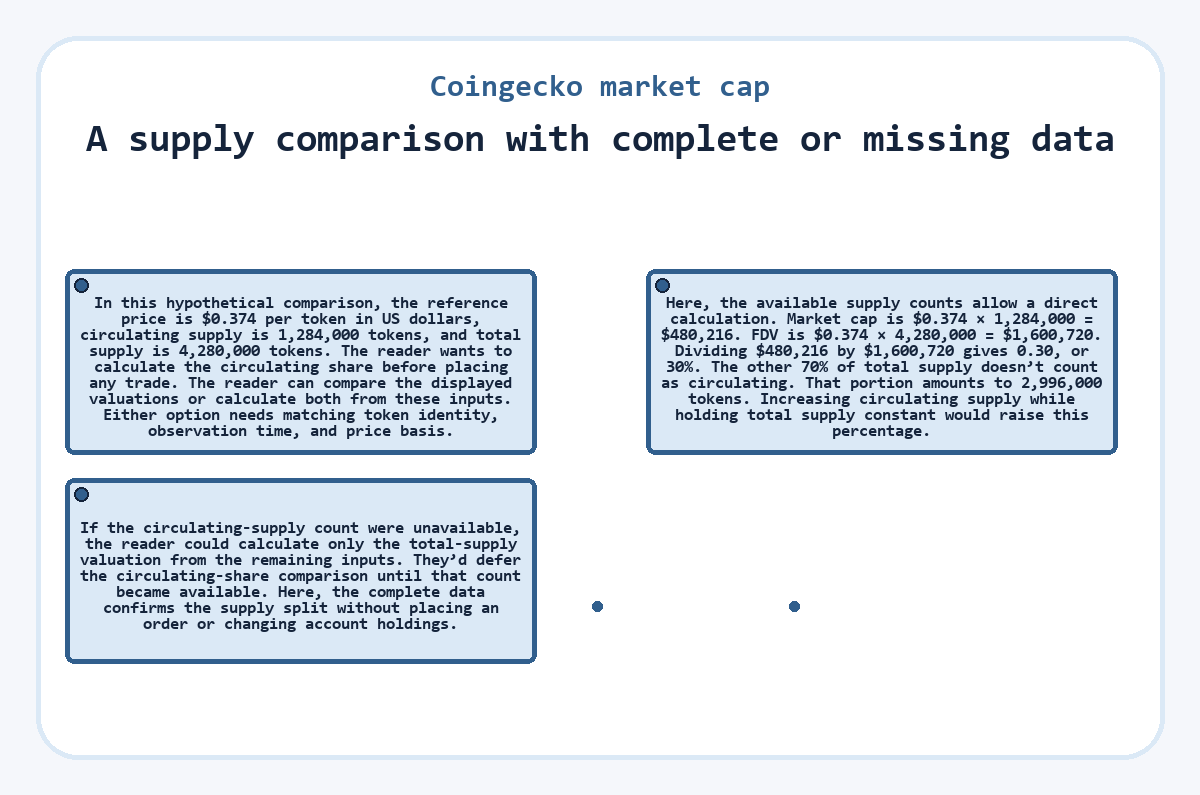
If the circulating-supply count were unavailable, the reader could calculate only the total-supply valuation from the remaining inputs. They’d defer the circulating-share comparison until that count became available. Here, the complete data confirms the supply split without placing an order or changing account holdings.
Does a higher market cap mean more money entered the token?
A higher market cap doesn’t establish an equivalent amount of net cash inflow. Reference prices apply to all circulating tokens. Trades that move a quoted price can therefore change the valuation by much more than their own cash value. Historical market-cap charts can reflect changes in circulating supply as well as changes in price.
Available liquidity governs execution at a market, including the effect of trade size on price. Trading volume records turnover over a period; it doesn’t measure how much can be sold immediately near the reference price. A large valuation can coexist with thin liquidity. When the question concerns an actual purchase, the relevant trading pair and available depth matter alongside supply dilution.
When price stays unchanged, additional circulating supply raises the displayed market cap without raising the price of each token.
Release timing behind similar circulation ratios
Tokens with the same circulation ratio can face different release pressures, because excluded supply may unlock gradually, arrive in a large scheduled tranche, or remain in reserves. A cliff unlock releases a specified allocation at a scheduled point. Linear vesting releases allocations progressively under the schedule. A release’s size relative to circulating supply describes potential public-float expansion if those tokens enter circulation. Its percentage of total supply uses a different denominator. A large excluded reserve with no defined distribution plan differs from an allocation with an approaching release date.
Recipient categories add context, since investors, team members, and ecosystem funds can have different purposes for their tokens. A release schedule shows availability conditions; it doesn’t prove that recipients will sell.
Unlocked tokens can still fall outside circulating supply when substantial project holdings remain reserved for stated purposes. Inclusion depends on the methodology and allocation details. The reported circulating count may therefore stay unchanged after an unlock.
Total-supply FDV, maximum issuance, and allocated reserves
A total-supply FDV can match circulating market cap while future minting remains possible, so a ratio near 1 doesn’t settle the question of future dilution. Maximum supply describes the permitted issuance ceiling when a project has one. If more tokens can still be issued, a valuation based on present total supply doesn’t price all future issuance. The issuance rules remain relevant even when the existing supply already circulates.
A valuation using maximum supply answers a different question: what that ceiling would be worth at the selected price. Where no finite maximum exists, that end-state calculation lacks a finite supply ceiling to multiply. Total-supply FDV can still describe existing supply if its inputs are available. The absence of a finite cap doesn’t by itself imply missing market-cap data.
Outstanding Token Value (OTV), when displayed, adds another supply distinction. It multiplies price by outstanding supply, excluding unplanned or unallocated tokens from total supply. Allocated tokens with defined circulation plans can remain relevant to that measure before they count as circulating. OTV therefore doesn’t replace market cap or an unlock schedule. Before buying, decide whether the upcoming releases and trading liquidity justify the valuation being considered.
Everyday questions about Coingecko market cap
Why do two trackers report different market caps for the same token?
Trackers can report different market caps because their price inputs or circulating-supply classifications differ. Updates can also reach them at different times. A meaningful comparison uses the same token identity, reference currency, and observation time. The remaining discrepancy may come from how each tracker counts team holdings, locked allocations, or other noncirculating tokens.
Does a token burn automatically increase market cap?
A token burn doesn’t automatically increase market cap. At an unchanged price, burning circulating tokens reduces both market cap and total-supply FDV. Burning reserves outside circulation reduces total-supply FDV while leaving market cap unchanged at that price. A price increase can offset a supply reduction, although the burn doesn’t determine that market response.
Can a target market cap reveal a token’s future price?
A target market cap gives an implied price only if you also assume the circulating supply for that same future date. Dividing that valuation by circulating supply gives a price in the same reference currency. Unlocks and new issuance can change the denominator, and the chosen market cap remains an assumption.
Why can historical market-cap data change without a price revision?
Recent date-specific API market-cap values can change while late or corrected circulating-supply data is still arriving. Price can stay unchanged because supply is the revised input. Same-day and next-day market caps on these date-specific endpoints are provisional until the final scheduled recalculation two days after the date. Current-value endpoints aren’t subject to this settling period. Comparing dates requires each date’s corresponding supply, rather than applying today’s circulating count to an older price.
Are bridged and wrapped tokens counted in the global market cap?
Bridged and wrapped tokens are excluded from the platform’s global market-cap total to avoid counting the same underlying value twice. Their individual supply figures can still be tracked. Adding every displayed representation can overstate the combined value relative to the global total, even when each individual supply figure is accurate.